GC and MGC: the two gold contracts
Gold futures trade on COMEX, part of CME Group. Most retail and prop-firm traders use one of two contracts. They track the same price; the difference is size.
| GC (Gold) | 100 troy ounces. One tick is $0.10 = $10.00. One full point = $100. |
| MGC (Micro Gold) | 10 troy ounces, one tenth of GC. One tick is $0.10 = $1.00. One full point = $10. |
| Trading hours | Sunday to Friday, 6:00 p.m. to 5:00 p.m. ET, with a one-hour break each day from 5:00 p.m. ET. |
MGC lets you size positions in smaller steps, which is why it is popular for evaluation and smaller funded accounts. Check the contract specifications on CME Group's site before trading; exchanges can change them.
The sessions that move gold
Gold trades nearly around the clock, but its intraday structure is shaped by a few windows. Each one tends to leave behind highs and lows that later sessions trade back into.
- Asia (evening ET). Usually the quietest stretch. Its range often becomes the first set of levels the next session runs.
- London open (around 3:00 a.m. ET). Volume picks up and price frequently tests the Asia high or low.
- New York morning. U.S. economic data at 8:30 a.m. ET and the COMEX day-session open at 8:20 a.m. ET bring the heaviest volume of the day. London and earlier New York highs and lows are common targets.
That pattern of building a range, then running the levels at its edges, is what a liquidity-and-structure framework is built to read. Session highs and lows are exactly the kind of levels where stop orders collect.
How ATLAS reads a gold session
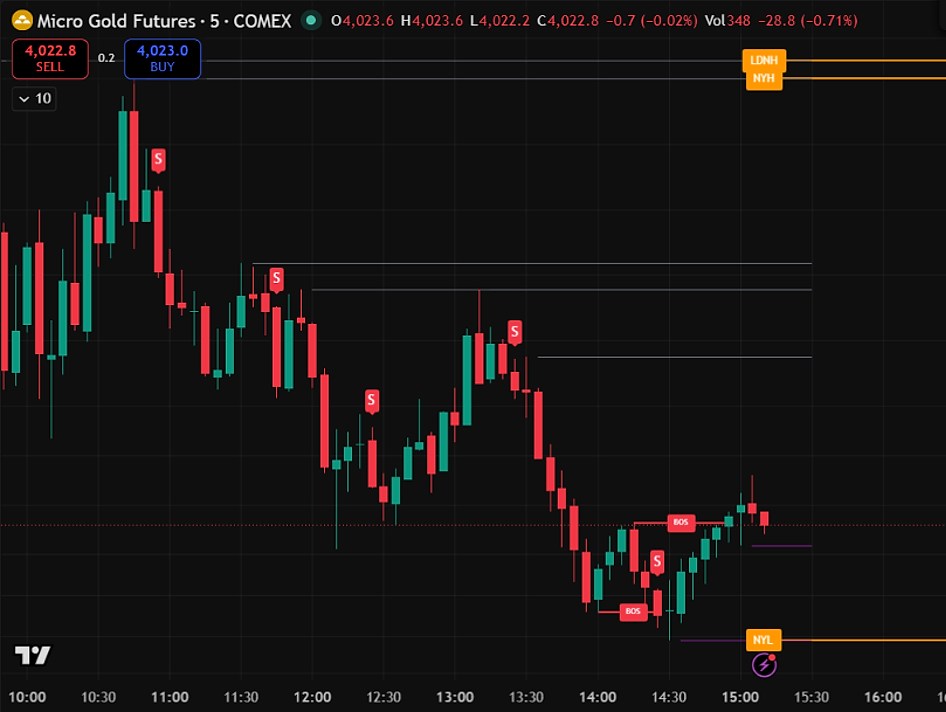
ATLAS applies the same sequence to gold as to any market. It takes direction from 4H and 1H structure, tracks session and swing highs and lows as liquidity, treats a sweep of one of those levels as the start of a setup, and only prints a buy or sell after its confirmation sequence completes in the direction of the higher-timeframe bias. CVD runs alongside so you can see whether order flow agrees. The features page describes each module.
On a trending gold day, the result is often a run of signals on one side only, because the bias filter will not print a signal against the higher-timeframe direction.
A starting setup for gold
- Chart MGC on the 5-minute timeframe. It is the most-tested configuration. ATLAS reads 4H and 1H structure on its own, whatever chart timeframe you use.
- Set the instrument value. Enter the point value for the contract you trade ($10 for MGC, $100 for GC) so ATLAS's risk figures match your position.
- Enable only the sessions you trade. For most gold traders that means London, New York morning, or both. ATLAS will not arm setups outside the windows you enable.
- Leave the entry sequence on defaults for your first sessions, and watch how signals line up with the session levels before changing anything.
- Set your daily trade limit and kill-switch before the first trade, not after a bad one.
The docs walk through each step on TradingView.
GC or MGC on the chart?
Price is effectively the same on both, so structure, levels, and sweeps look the same. Volume is not: GC trades more contracts, so volume-based readings such as CVD can look smoother on GC. ATLAS calculates from whichever symbol is on your chart, so pick the one you trade and keep it consistent.
Things to know about gold intraday
- Data releases. CPI, payrolls, and Fed decisions can move gold several dollars in seconds. Many traders stand aside around them.
- Overnight ranges. Thin Asia trading can produce small, choppy ranges that do not hold up once London volume arrives.
- Contract rolls. Gold futures roll to a new active month several times a year. Use TradingView's continuous contract (for example MGC1!) so levels do not jump at the roll.